
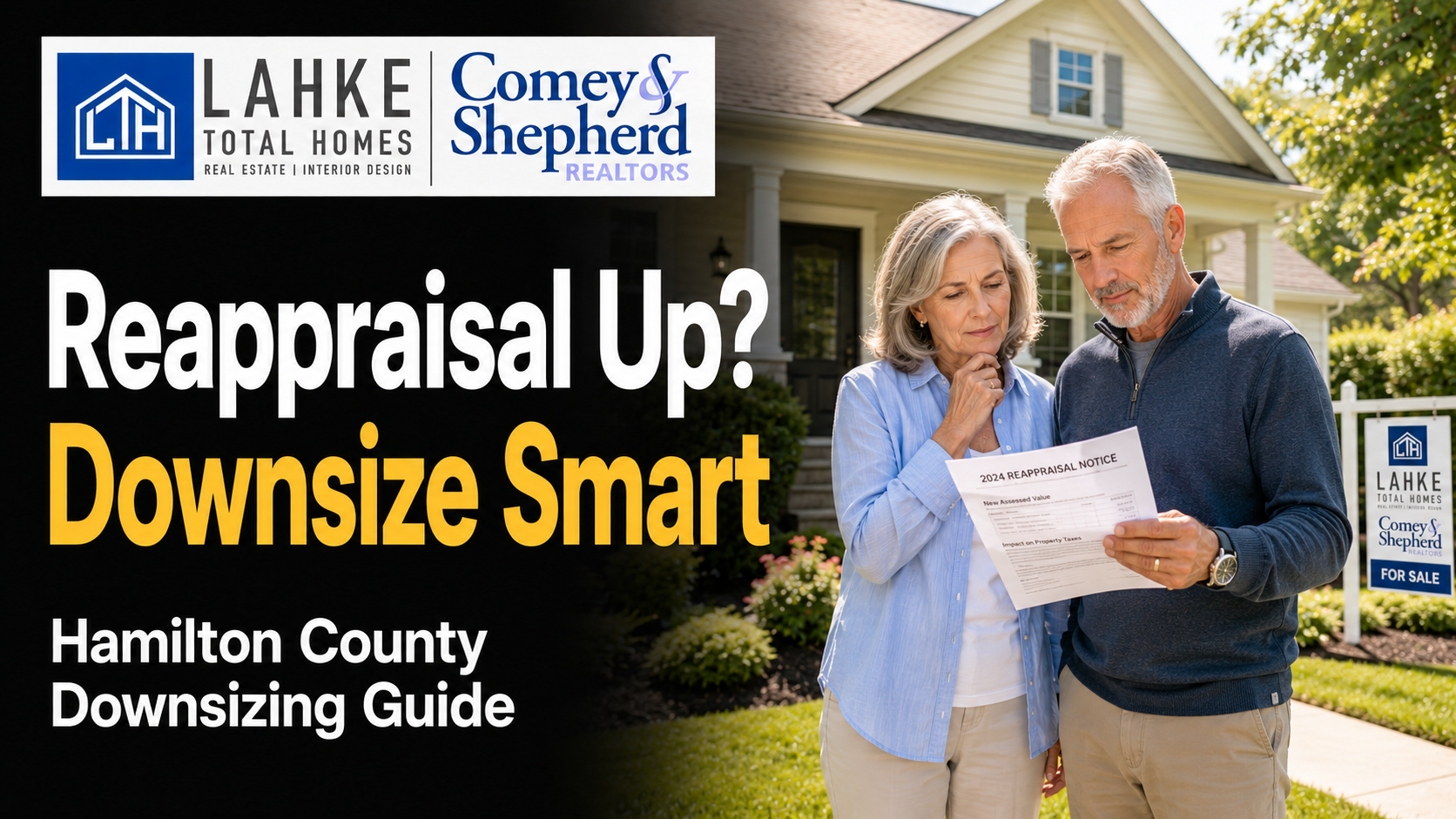
What does Hamilton County's 2024 reappraisal mean for homeowners who want to downsize?
Hamilton County's 2024 sexennial reappraisal pushed residential property values up an average of 35% countywide, with those new assessed values taking effect for tax year 2025. For downsizers, that number cuts two ways: it likely means more equity walking out the door at closing, but it also means a higher tax bill on your current home in the meantime, and a process you need to understand before you list.
The Reappraisal and What It Actually Changes for You
Let's start with what the reappraisal does and doesn't do. A higher assessed value doesn't automatically mean your tax bill jumped by the same 35%. Ohio's Ohio Realtors and county guidance both point to the fact that millage rates, levies, and exemptions all factor into the final bill. The assessed value is the starting point, not the finish line.
That said, for many Hamilton County homeowners, the 2024 reappraisal did produce a meaningful increase in the tax bill that arrived in 2025 and beyond. If you've been in your home for 10 or 15 years, the jump from your previous assessed value to the new one can feel significant.
Here's the strategic piece I tell every client in this situation: a higher assessed value is also a signal about your equity position. If the county says your home is worth substantially more than it was six years ago, the market likely agrees. That's real money you can put to work in your next chapter, whether that's a smaller single-level home, a low-maintenance new construction build, or something in between.
For a deeper look at how the move itself affects your tax picture going forward, I'd point you to my earlier post on whether downsizing will lower your property taxes in Cincinnati, it covers the mechanics in detail.
How assessed value and sale price relate (and where they diverge)
One question I get constantly: "Does a higher county appraisal mean I can price my home higher?" The honest answer is: sometimes, but not automatically.
The county's assessed value is based on a mass appraisal of comparable properties across an entire reappraisal cycle. It's a useful data point, but it's not the same as a current market valuation driven by what buyers are actually paying today on your specific street, in your specific condition, with today's inventory levels.
I've seen homes where the county's new value was conservative compared to what the market would bear. I've also seen cases where a homeowner assumed the reappraisal justified a price that buyers wouldn't support. Pricing right the first time almost always nets you more than chasing a number that sits on the market and accumulates days.
The right move is to get a current comparative market analysis from someone who knows your neighborhood, not to anchor your list price to a county assessment.
| Data Point | What It Reflects | How Useful for Pricing? |
|---|---|---|
| County assessed value (2024 reappraisal) | Mass appraisal of countywide comparables; effective tax year 2025 | Useful context, not a list-price anchor |
| Automated valuation (Zillow, etc.) | Algorithm-driven estimate; no interior condition data | Starting point only; often off by meaningful margins |
| Comparative market analysis (CMA) | Recent closed sales of similar homes in your area | Most reliable pricing input for active listings |
| Licensed appraisal | Individual property assessment by a certified appraiser | Highest precision; typically ordered by lender at contract |
One of the biggest mistakes I see downsizers make is waiting too long to plan the move and then feeling rushed into decisions they weren't ready to make. The timing of your sale and your next purchase is where most of the stress originates, and it goes much more smoothly when you've had time to think it through before you list.
If you're weighing whether a new construction single-level home makes sense as your next step, my post on what to know before building a new construction single-level home in Cincinnati walks through that process in detail.
Frequently Asked Questions
How much did Hamilton County property values increase in the 2024 reappraisal?
According to Cincinnati Enquirer reporting on the reappraisal, Hamilton County residential values rose an average of about 35% countywide, though the increase varied by municipality. Those new values took effect for tax year 2025. Some areas saw larger increases, some smaller, your specific property's change depends on your location and prior assessed value.
Will my Hamilton County property taxes go up automatically after the reappraisal?
A higher assessed value doesn't translate directly into a proportional tax increase. Your actual bill depends on local millage rates, any levies in your taxing district, and exemptions you qualify for (such as the homestead exemption). The county's reappraisal sets the assessed value; the tax bill is calculated from there. Contact the Hamilton County Auditor's office directly for your specific figures.
Does a higher county appraisal mean I can price my home higher when I sell?
Not automatically. The county's assessed value is based on a mass appraisal of comparable properties across a reappraisal cycle, it's useful context, but it's not the same as a current market valuation. What buyers will actually pay today depends on recent comparable sales, your home's condition, and current inventory in your area. A comparative market analysis from a local agent is a more reliable pricing tool than the county assessment alone.
Hamilton County's 2024 reappraisal is a real planning moment for downsizers. It's reshaped your equity position, your tax picture, and the context in which buyers will evaluate your home. The sellers who navigate it well are the ones who plan ahead, price accurately, and get moving before they're under pressure.
If you're thinking about making a move in Hamilton, Butler, Warren, or Clermont County, I'd be glad to walk through your specific situation, your current assessed value, what the market is doing in your neighborhood, and what the process looks like from list to close. Let's talk about your move.
This article is provided for general informational purposes only and does not constitute legal, tax, or financial advice. Readers should confirm their specific closing costs, tax obligations, and transaction details with their attorney, tax advisor, lender, or title/escrow officer. Duncan Lahke is licensed as an Ohio Real Estate Salesperson, regulated by the Ohio Division of Real Estate & Professional Licensing. Equal Housing Opportunity.
Check out this article next